
A word before the list: we make Physioly, and we put it first. That is the obvious bias, so the bar we used is written down: the best choice for a solo physio or a small clinic that wants records, diary, exercises and payments working this week, without a monthly bill before it pays for itself. If you claim Medicare, run eight physios or need patients to book themselves online, a different name on this list will serve you better, and we say which.
Competitor prices were read on their official pages on 28 September 2026, in the currency each one shows. They change. Check before you sign.
The 5 best physio practice management software tools compared
| Software | 1 physio / month | 3 physios / month | SMS reminders | Claiming | Free plan or trial |
|---|---|---|---|---|---|
| 1. Physioly | Free · US$29 | US$95 | None (patient link) | None | Free for good; first 7 days unlimited |
| 2. Cliniko | A$45 · £29 | A$95 · £59 | Paid per message | Via Tyro Health (AU) | 30 days, no card |
| 3. Jane | £29 (20 appts) · £44 | £82 · C$149 | Included on Practice and Thrive | Add-on (CA, UK) | Demo only |
| 4. Nookal | A$49 · £29 | A$133 · £80 | From A$0.07 each | Widest list, paid per use | 30 days, no card |
| 5. Zanda | A$29 · £15 | A$117 · £55 | Paid per message | Medicare, DVA via Tyro | 14 days, no card |
1. Physioly — best for solo physios and small clinics starting out
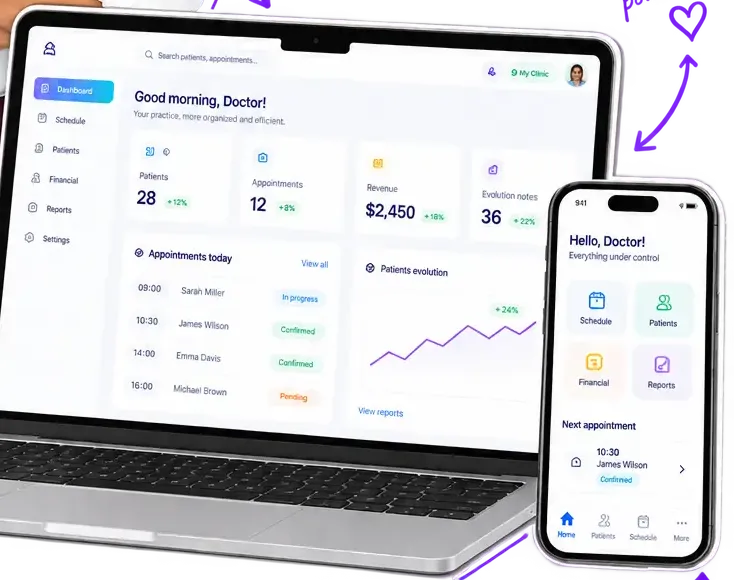
Physioly was built around the clinical record first. There are assessment forms per specialty (orthopaedic, neurological, pelvic health and others), a pain scale that draws its own progress chart, a range-of-motion table by joint and movement, and a body map you click to mark where it hurts. Home exercise programmes with 3D demonstrations are in every plan, not a separate subscription.
Around the record: a diary per practitioner with group classes, session packages, overdue payments, and PDF reports. Each patient gets a personal link with their appointments, exercises and payments, which you send by WhatsApp or any messenger.
What it does not do, and this matters: no online self-booking, no automatic SMS, no Medicare, health-fund or insurer claiming, no built-in video calls. Reminders are written for you and sent by you, in one tap.
Price: free with 1 patient, for good. US$29 up to 20 patients, US$39 up to 100, US$65 with no limit. Practice plans are US$95 for three practitioners and US$239 for up to ten.
2. Cliniko — best for Australian clinics that claim
Cliniko charges per band of practitioners, so two to five physios pay the same A$95 or £59. Every feature is in every plan, telehealth included, and the price has not moved since 2011. SMS is bought separately. Claiming in Australia and exercise programmes come through connected apps with their own fees. Full numbers in our Cliniko pricing breakdown.
3. Jane — best for Canadian clinics and part-time teams
Jane charges a plan with one full-time practitioner plus a licence per extra one, half price for anyone working under 24 hours a week. That is the fairest model we found for part-time staff. SMS is unlimited on Practice and Thrive. Direct billing in Canada and claim files in the UK come through an add-on. There is no free trial, only a demo. See the Jane App pricing breakdown.
4. Nookal — best if claiming is half your admin
Nookal has the longest claiming list of the five: Medicare, DVA, HICAPS, Tyro, NDIS, ACC and Healthcode, each charged as you use it. The per-practitioner price drops as you add seats. The patient portal is an add-on, and not on the cheapest plan.
5. Zanda — cheapest paid entry point
Zanda, formerly Power Diary, starts at A$29 or £15 for one practitioner on Starter, with a cap of 1,000 appointments. Growth adds a fee per extra practitioner. Medicare and DVA claims carry no extra cost; SMS does. It also offers a 12-month money-back guarantee.
Halaxy, WriteUpp and TM3 nearly made the list. All three are in our longer country-by-country comparison.
See Physioly in action
Open a demo clinic with patients already in it. No sign-up, nothing to install.
How clinic management software solves the problems physios face
The problems are boring, which is why they eat the week.
Notes that live in three places. Paper for the assessment, a Word file for the progress notes, the measurements in your head. Software puts them on one screen per patient, dated, and searchable when the insurer or the patient asks. We wrote more about what to record and how long to keep it.
No-shows. A reminder the day before cuts most of them. Whether it goes by automatic SMS (Cliniko, Jane, Nookal, Zanda) or by a link you send yourself (Physioly) is a real difference in effort, and you should decide which one you want before you compare prices. More on that in reducing no-shows.
Money you forgot to collect. The session was on Tuesday, the payment was “next time”, and next time was three weeks ago. A list of overdue payments per patient is the feature physios underrate most.
Exercises on a photocopy. Patients lose paper. A link with the programme on their phone gets opened. Most products here connect to a paid exercise app for this; check what that adds per practitioner.
Automating practice admin: the recurring course of treatment
Physio is rarely one appointment. It is ten sessions, twice a week, paid up front or per visit, with a reassessment around session six. That pattern is where software either saves you an hour a week or costs you one.
What good software does with a course of treatment:
- Books the series at once. Tuesdays and Thursdays at 8:00 for five weeks, in one go, and moves one session without breaking the rest.
- Counts the package. Session 7 of 10, paid; two left, so the conversation about renewing happens on time and not after the fact.
- Reminds you to reassess. The pain scale and range of motion recorded at the start sit next to today’s, so the progress chart builds itself.
- Keeps the exercises current. When you progress the programme, the patient’s link shows the new one.
In Physioly, packages, the progress chart and the exercise link are all part of the record. In the others, packages are generally there; exercise programmes usually mean a connected app.
How to choose the right software for your practice
Start from the thing you cannot live without, not from the feature list.
- You claim Medicare, DVA or health funds every day: Nookal or Cliniko. Physioly does not claim.
- You are in Canada and direct-bill: Jane.
- Patients must book themselves online: anything here except Physioly.
- You are starting out or have a modest caseload: Physioly’s free plan, or Zanda Starter if you need SMS.
- You prescribe a lot of home exercise: count the exercise app in the price. Physioly includes it.
Then do the thing nobody does: put a real week in the trial. Your actual Tuesday, your actual patients. In five days you will know whether the diary fits the way you work, which no comparison table can tell you.
Questions we get asked
What is the best physiotherapy clinic management software?
It depends on what you cannot do without. For a solo physio or a small clinic starting out, Physioly has a permanent free plan and includes exercise programmes. Australian clinics that claim a lot usually pick Cliniko or Nookal; Canadian clinics that direct-bill usually pick Jane; Zanda is the cheapest paid entry point.
How much does physiotherapy practice management software cost?
For one practitioner, between free and about A$49 or £29 a month. For three practitioners, roughly A$95 to A$133, £55 to £82, or US$95. SMS reminders, claiming and exercise apps are often charged on top.
Is there free physiotherapy clinic software?
Physioly has a free plan with 1 patient that does not expire, with the first 7 days unlimited. Halaxy has a free core and charges credits for SMS, video and claims. The others offer trials of 14 to 30 days, and Jane offers a demo.
Does Physioly send automatic SMS reminders?
No. Physioly writes the reminder and you send it by WhatsApp or any messenger in one tap, and each patient has a personal link with their appointments. If automatic SMS is a must, Cliniko, Jane, Nookal and Zanda all have it.
Which physio software handles packages and courses of treatment?
All five handle recurring appointments. Physioly also tracks session packages, overdue payments and the progress chart inside the patient record, and includes home exercise programmes in every plan.

Thainan Prado is a software developer and the founder of Physioly, which started in Brazil as Fisioly. He builds the system alongside the physiotherapists who use it every day, and writes about what software can and cannot fix in a practice.